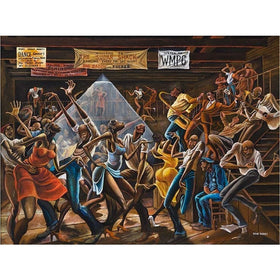
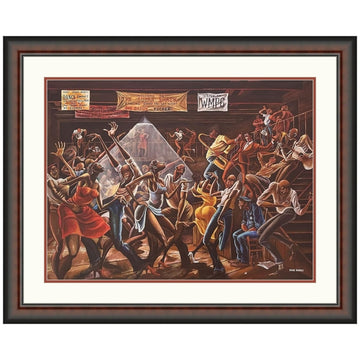
Jitterbug: Negro Juke Joint




- Available in multiple display options: stretched canvas, black frame with single mat, black frame with double mat, and unframed print.
- Historic FSA photograph by Marion Post Wolcott capturing the joy of Jitterbug dancing in a Mississippi Delta juke joint, November 1939, outside Clarksdale, Mississippi.
- A meaningful celebration of African American cultural heritage, Black joy, and the juke joint tradition that shaped American music history.
- Perfect for collectors of African American art, Black history enthusiasts, music lovers, and anyone who appreciates powerful documentary photography.
Saturday night in the Mississippi Delta, November 1939. The cotton was picked, the work week was over, and somewhere down a dirt road outside Clarksdale, the music started playing.
This celebrated photograph by Marion Post Wolcott captures a couple lost in the Jitterbug inside a juke joint decorated with paper streamers. Their feet shuffle against bare wooden floorboards. Their smiles need no caption. Around them, onlookers watch, wait their turn, and soak in the rhythm of a Saturday night ritual that sustained Black communities across the rural South.
Wolcott took this photograph on assignment for the Farm Security Administration (FSA), a New Deal agency that sent photographers into the American countryside to document everyday life during the Great Depression. Working alongside legends like Dorothea Lange and Walker Evans, Wolcott produced over 9,000 photographs between 1938 and 1942. Her images of the Jim Crow South stand among the most vivid and intimate records of African American life during this era.
The Jitterbug, a lively offshoot of the Lindy Hop, was born in the Black dance halls and ballrooms of Harlem during the late 1920s. Dancers at the legendary Savoy Ballroom blended Charleston, jazz, tap, and breakaway moves into something electrifying, full of improvisation and athletic grace. By the late 1930s, that energy had traveled south into juke joints, dance halls, and gathering places across the Delta.
Juke joints hold a singular place in African American cultural history. During Jim Crow, when Black people were barred from white establishments and often forbidden from gathering in groups, juke joints became sanctuaries. Set up in sharecropper shacks, roadside buildings, and converted homes, they were places where a community could exhale after six days of grueling labor. Blues legends like Robert Johnson, Son House, and Charley Patton played the juke joint circuit, and the music born in those rooms would reshape American culture forever. As the Mississippi Encyclopedia notes, juke joints were the first secular cultural spaces to emerge among African American freedmen, and they remain vital to Delta culture to this day.
This print brings that energy into your home. Every detail of Wolcott's original composition is faithfully reproduced, from the dancers' fluid motion to the watching crowd along the wooden walls. The image is sourced from the Library of Congress Farm Security Administration/Office of War Information collection (LC-USF34-052594-D), ensuring archival accuracy and the highest quality reproduction.
Available as a stretched canvas, a framed print, a framed print with double mat, or an unframed print, this piece makes a striking addition to any space dedicated to African American history, Southern culture, or the roots of American music and dance.
| Edition | Open Edition |
| Framed | Available framed or unframed |
| Height | Avaialable in a variety of sizes. Choose your size of preference. |
| Length | Avaialable in a variety of sizes. Choose your size of preference. |
| Medium | Paper or Canvas |
| Signed | Unsigned |
| SKU | RM035 |
| Year Released | 1939 |
Marion Post Wolcott
Marion Post Wolcott (1910-1990) was an American documentary photographer whose work for the Farm Security Administration between 1938 and 1942 produced over 9,000 images of rural American life during the Great Depression. Traveling alone through the Deep South, she captured the realities of poverty, racial segregation, and everyday resilience in African American communities with a candid intimacy that set her apart from her contemporaries. Her photographs are held in the collections of the Library of Congress, the Metropolitan Museum of Art, and the Smithsonian Institution, and she received the Dorothea Lange Award and the National Press Photographer's Lifetime Achievement Award for her contributions to American photography.Most in stock items ship in 0 to 5 business depending upon the shipping method selected during checkout. Large framed artwork requires an additional 1 to 5 days of processing time to allow for framing. All orders over $250 ship signature required. Pre-Orders, identified by a “Reserve Now” checkout button, can take 3 to 14 business days to process and ship. If there is an issue with your order we will notify you with 1 to 2 business days. For additional information please visit our: Shipping Policy